What indicators of Triazinamide need to be tested before Pymetrozine synthesis
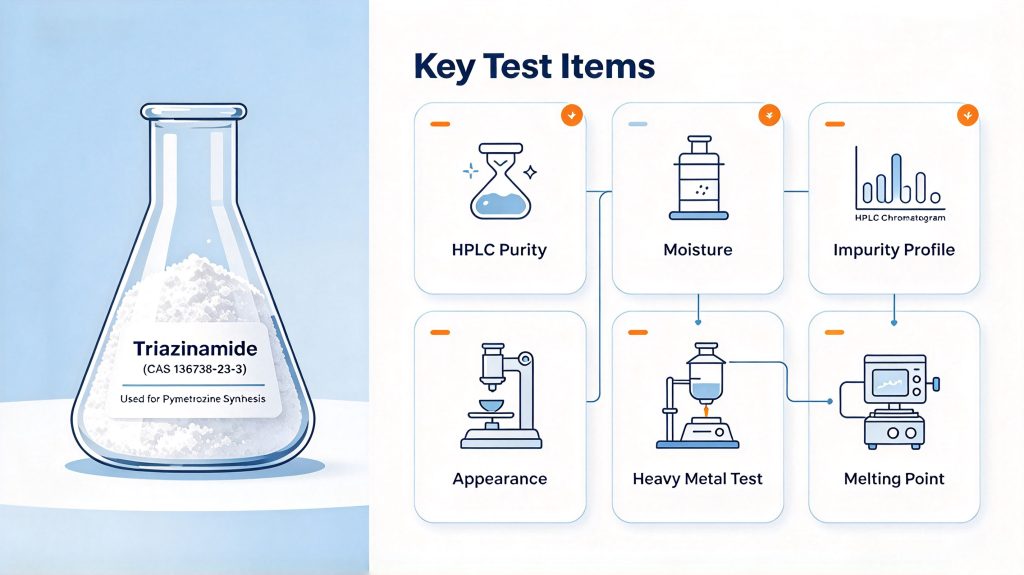
Triazinamide (CAS No.: 136738-23-3) acts as the critical raw intermediate for Pymetrozine synthesis. Before feeding Triazinamide into the Pymetrozine production reactor, multiple quality indicators must be fully tested. Unqualified Triazinamide will reduce reaction conversion rate, introduce harmful impurities, lower Pymetrozine technical purity and block export registration approval. Below lists all essential test indicators for Triazinamide for Pymetrozine manufacturing.
Test Triazinamide HPLC Purity for Stable Pymetrozine Yield
The primary test indicator of Triazinamide is HPLC purity. For commercial Pymetrozine production, Triazinamide HPLC purity is normally required ≥96%, while high-end export-grade Pymetrozine demands Triazinamide purity ≥98%. Low-purity Triazinamide contains unreacted precursors and by-products, which will directly cut down condensation conversion rate, reduce Pymetrozine yield and increase waste treatment cost. HPLC detection quantifies the main content of Triazinamide (CAS No.: 136738-23-3) and gives the baseline for batch release before Pymetrozine synthesis.
Detect Moisture and Loss on Drying of Triazinamide
Moisture / loss on drying of Triazinamide is another mandatory test item. Excess moisture in Triazinamide can cause side hydrolysis reactions during Pymetrozine condensation, generate extra organic impurities and make the final Pymetrozine product darker in color. Normally, loss on drying of Triazinamide for Pymetrozine synthesis should be controlled ≤3%. This test prevents hydrolysis side reactions and guarantees consistent reaction environment in Pymetrozine synthesis.
Inspect Appearance and Physical Form of Triazinamide
Visual inspection for Triazinamide appearance must be performed before Pymetrozine synthesis. Qualified Triazinamide (CAS No.: 136738-23-3) is white or off-white crystalline powder. Yellowing, discoloration, caking or dark particles mean Triazinamide has degraded or absorbed impurities during storage. Caked Triazinamide leads to uneven feeding and incomplete dissolution, which causes unstable local reactant ratio and inconsistent Pymetrozine batch quality.
Test Related Impurity Profile of Triazinamide
Testing related impurities of Triazinamide is vital for Pymetrozine export registration. Trace intermediate residues, amine impurities and heavy metal impurities in Triazinamide will carry over into finished Pymetrozine technical material. Some impurities are toxicologically relevant and may fail FAO, EU or EPA registration review. The impurity profile test of Triazinamide identifies unknown impurities and limits single impurity content, ensuring Pymetrozine meets international agrochemical standards.
Measure pH Value and Water Insoluble Substances of Triazinamide
pH value and water-insoluble substances of Triazinamide need testing before Pymetrozine synthesis. Abnormal pH will disturb the catalytic system of the condensation reaction between Triazinamide and nicotinaldehyde. Water-insoluble particles in Triazinamide may block pipelines and filter equipment, cause poor crystallization of Pymetrozine and bring extra solid waste. This check avoids equipment clogging and maintains stable pH condition in Pymetrozine reaction.
Test Heavy Metals and Residual Salts in Triazinamide
Heavy metals and inorganic residual salts in Triazinamide require detection for Pymetrozine export products. Heavy metal residues such as lead, arsenic and cadmium from Triazinamide raw materials will remain in Pymetrozine technical product. Many global pesticide registration regulations set strict heavy metal limits. Controlling heavy metals and residual salts of Triazinamide supports successful overseas registration of Pymetrozine.
Melting Point Test of Triazinamide for Identity Confirmation
Melting point measurement serves as a fast identity verification method for Triazinamide (CAS No.: 136738-23-3). If the measured melting point deviates significantly from the standard value, it proves the Triazinamide batch may be adulterated or severely degraded. This simple test quickly confirms whether incoming material is genuine Triazinamide before starting Pymetrozine synthesis, preventing wrong raw material feeding.
Particle Size Test of Triazinamide for Feeding and Dissolution
Particle size distribution of Triazinamide affects dissolution speed in Pymetrozine synthesis. Too coarse Triazinamide powder dissolves slowly and leads to local low concentration; ultra-fine powder easily creates dust and agglomeration. Appropriate particle size ensures Triazinamide dissolves uniformly in reaction solvent, stabilizes reaction speed and keeps Pymetrozine crystal quality consistent batch by batch.