How do impurities in Triazinamide affect the yield of Pymetrozine production?
Triazinamide (CAS No.: 136738-23-3) is the critical penultimate heterocyclic intermediate for industrial Pymetrozine manufacturing. The impurity profile of Triazinamide directly changes reaction stoichiometry, triggers side reactions, reduces conversion rate, and lowers the final isolated yield of Pymetrozine in the condensation and cyclization workflow.
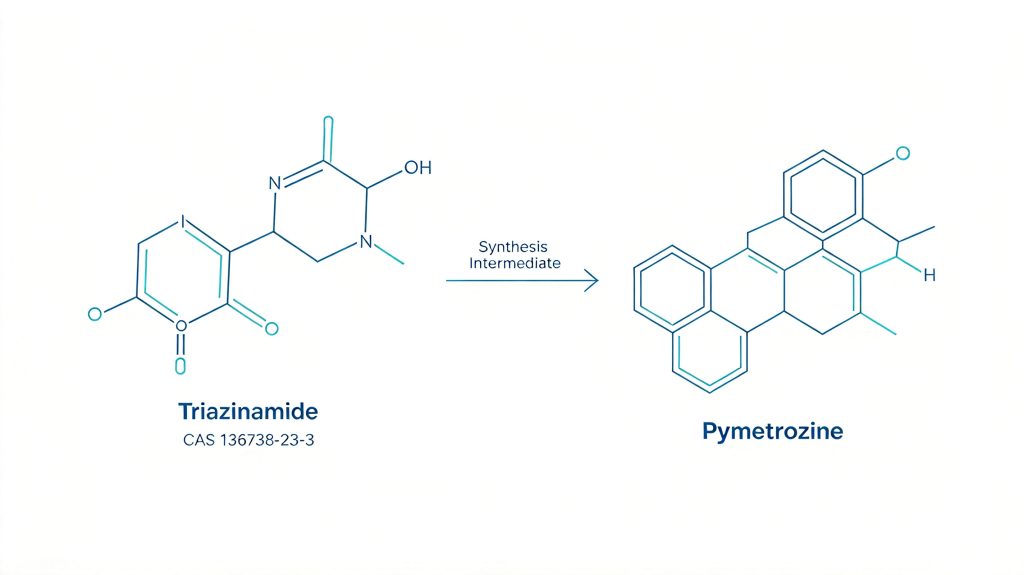
Common Impurities inside Triazinamide (CAS 136738-23-3) That Harm Pymetrozine Yield
Typical impurities in crude Triazinamide include unreacted oxadiazolone precursor, hydrolyzed aminotriazinone, residual hydrazine salts, acetate by-products and triazine polymer oligomers. These impurities come from incomplete ring-expansion cyclization during Triazinamide synthesis. Even trace levels can interfere with the next condensation step between Triazinamide and nicotinaldehyde to form Pymetrozine.
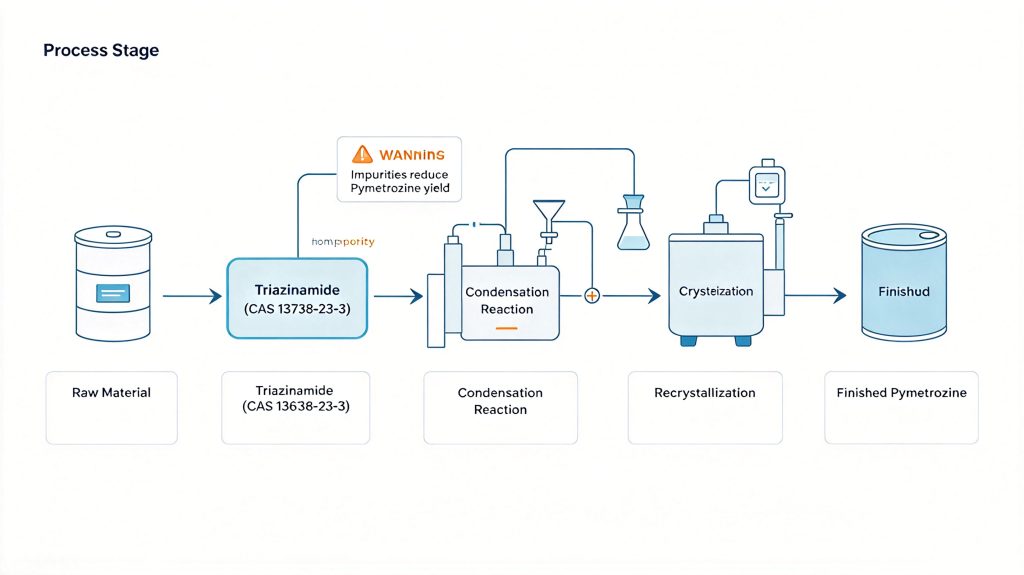
Core Mechanisms – How Triazinamide Impurities Cut Pymetrozine Yield
1. Competitive Side Consumption of Raw Materials
Nucleophilic impurities in low-grade Triazinamide compete with qualified Triazinamide (CAS 136738-23-3) to react with nicotinaldehyde. This consumes the aldehyde feedstock out of target route, producing stable triazine byproducts that cannot convert into Pymetrozine. More side products mean less main product, dragging down Pymetrozine yield sharply.
2. Inhibition of Cyclization & Condensation Kinetics
Polymeric triazine impurities and heavy metal residues inside Triazinamide act as reaction poisons. They adsorb on the reaction interface, slow down the ring-closing condensation and suppress the forward reaction equilibrium. In continuous industrial Pymetrozine lines, this issue causes unstable batch yield and larger yield fluctuation between runs.
3. Increased Product Loss During Purification
Impurities carried over from Triazinamide will co-crystallize with crude Pymetrozine. Operators need extra recrystallization, washing and filtration steps to reach required HPLC purity. Each extra purification stage dissolves and loses part of Pymetrozine solid, further reducing the final harvest yield.
4. Stoichiometric Deviation for Dosing Calculation
If Triazinamide contains high inert impurities, the effective content of active Triazinamide (CAS 136738-23-3) is lower than labelled value. When production teams follow the original molar ratio for Pymetrozine synthesis, nicotinaldehyde or acid catalyst becomes excessive or insufficient, leading to incomplete conversion and yield drop.
Industrial Reference Data for High-Purity Triazinamide for Pymetrozine
High-quality Triazinamide (CAS 136738-23-3, ≥98.5% HPLC) normally supports stable Pymetrozine yield around 93–96% in the condensation step. If Triazinamide purity falls below 95% with high polymer impurities, Pymetrozine yield may drop 5–12% in the same process parameters, together with rising waste treatment cost and higher registration risk for technical Pymetrozine.
Practical Control Strategy to Stabilize Pymetrozine Yield
Manufacturers should test impurity spectrum of incoming Triazinamide (CAS 136738-23-3) by HPLC before feeding. Purify crude Triazinamide via recrystallization to remove oligomers and hydrazine residues. Set strict specification limits for key impurities, which is the most cost-effective way to lock high and consistent Pymetrozine yield.
Conclusion
In short, impurities in Triazinamide (CAS No.: 136738-23-3) hurt Pymetrozine yield through competitive side reactions, kinetic inhibition, purification loss and stoichiometric mismatch. Controlling Triazinamide impurity levels is the foundation for stable, high-yield Pymetrozine production for agrochemical export and formulation.