What consequences will decomposed Triazinamide bring to Pymetrozine synthesis
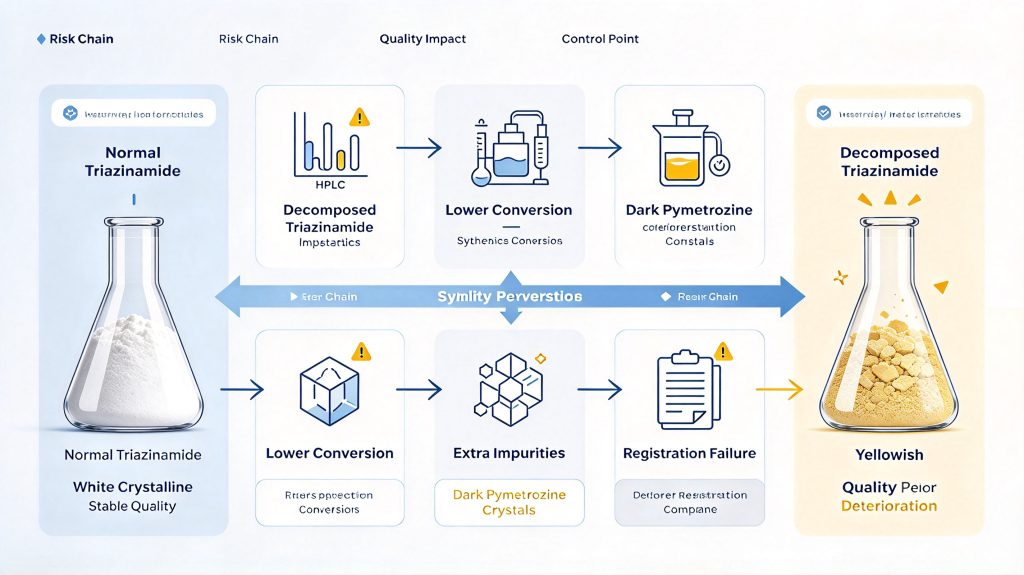
Triazinamide (CAS No.: 136738-23-3) is the core key intermediate for Pymetrozine synthesis. When Triazinamide decomposes during storage or transportation, its chemical composition changes and generates a variety of degradation by-products. Using decomposed Triazinamide as raw material will trigger a series of adverse outcomes in Pymetrozine synthesis, covering reduced reaction conversion, unstable product quality and failed export registration. This article explains the main risks of decomposed Triazinamide for Pymetrozine manufacturing.
Decomposed Triazinamide Reduces Pymetrozine Reaction Conversion Rate
Once Triazinamide (CAS No.: 136738-23-3) is decomposed, the effective content of active Triazinamide monomer decreases. During the condensation reaction for Pymetrozine production, insufficient active raw material directly lowers reaction conversion. The reactor will produce more unreacted residues, drop Pymetrozine yield and raise raw material consumption and production costs. Even if extra Triazinamide is added to compensate, the degradation impurities will still interfere with the reaction balance of Pymetrozine synthesis.
Degradation Impurities from Decomposed Triazinamide Lower Pymetrozine Technical Purity
Decomposed Triazinamide produces amine by-products and organic impurities. These impurities enter the reaction system together with Triazinamide and are difficult to remove in the subsequent purification process. They will remain in Pymetrozine technical material, reducing the main content of finished Pymetrozine. High impurity levels also cause inconsistent purity across batches, which is a major problem for commercial Pymetrozine suppliers.
Decomposed Triazinamide Causes Color Darkening of Finished Pymetrozine
Decomposition of Triazinamide forms colored oxidation by-products. When feeding deteriorated Triazinamide into Pymetrozine synthesis, these chromogenic impurities carry over into the final product. The finished Pymetrozine solid turns yellow or brown instead of standard off-white crystals. Discolored Pymetrozine not only fails to meet customer appearance requirements but also triggers doubts during overseas commodity inspection.
H3: Impurities from Decomposed Triazinamide Interfere with Pymetrozine Crystallization
Degradation fragments generated by decomposed Triazinamide act as crystal impurities in the Pymetrozine synthesis system. They disrupt the regular crystal growth of Pymetrozine. This issue leads to irregular crystal shape, fine crystal particles, poor filtering performance and longer centrifugation time. In severe cases, sticky solid precipitates form, blocking filter screens and pipelines and increasing production downtime.
Decomposed Triazinamide Increases Side Reactions in Pymetrozine Synthesis
The degradation by-products from decomposed Triazinamide can participate in undesired side reactions under the reaction temperature and catalyst conditions of Pymetrozine synthesis. Side reactions consume reaction solvent and catalyst, generate extra unknown impurities and complicate the post-treatment workflow. More waste liquid and solid waste are produced, lifting waste disposal pressure and environmental treatment costs for Pymetrozine factories.
H3: Decomposed Triazinamide Creates Risks for Pymetrozine Export Registration
For export-grade Pymetrozine, impurity profiles are strictly reviewed in global pesticide registration. Unknown impurities introduced by decomposed Triazinamide will appear in the HPLC spectrum of Pymetrozine technical product. Regulatory authorities such as EU and FAO require toxicology assessment for new unknown impurities. This may delay or reject Pymetrozine registration, causing huge losses for agrochemical export enterprises.
Decomposed Triazinamide Results in Unstable Pymetrozine Storage Stability
Pymetrozine synthesized from decomposed Triazinamide has poor long-term storage stability. The residual trace degradation impurities from Triazinamide will slowly trigger secondary reactions inside Pymetrozine technical product. Over storage time, Pymetrozine purity may gradually decline, and the product is prone to caking. This leads to product quality complaints after delivery to overseas buyers.