What Risks Will Improper Storage of Triazinamide Cause During Pymetrozine Production?
Triazinamide (CAS No.: 136738-23-3) is the critical penultimate heterocyclic intermediate for industrial Pymetrozine manufacturing. Its storage condition and internal impurity spectrum jointly determine conversion efficiency, batch stability, final yield and product compliance of Pymetrozine. Improper storage triggers Triazinamide degradation and generates new impurities; these impurities further interfere with the condensation and cyclization reaction to drag down Pymetrozine yield in mass production.
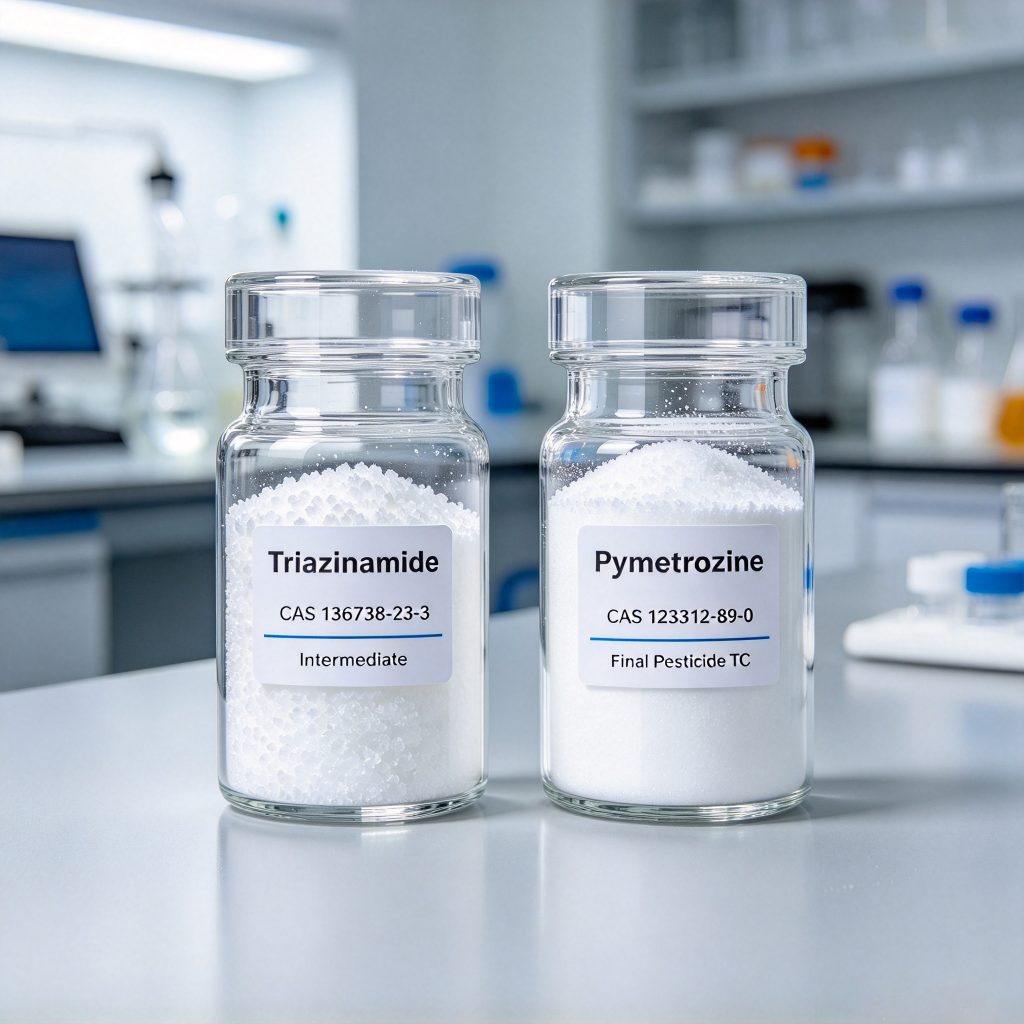
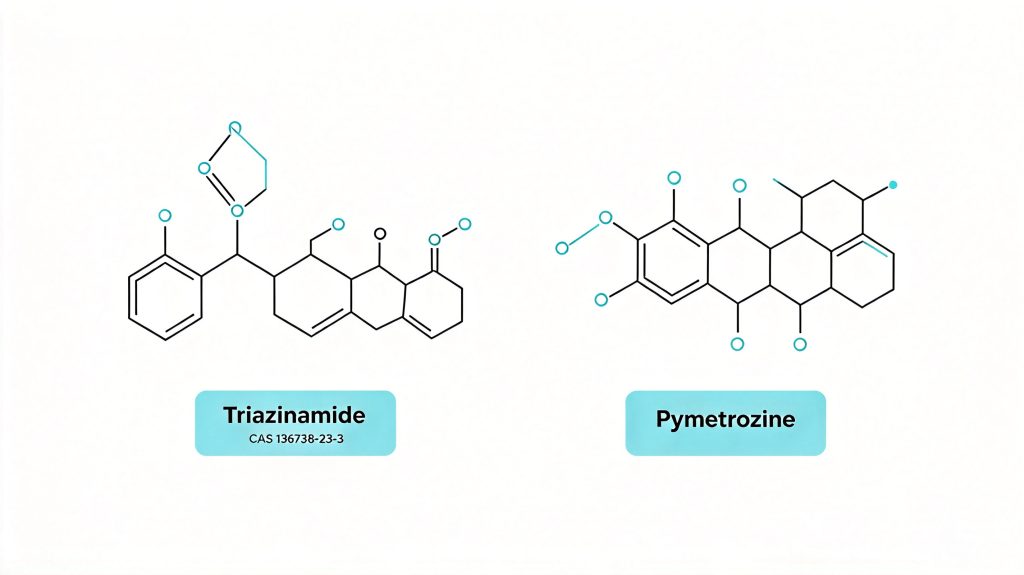
Risks Brought by Improper Storage of Triazinamide (CAS 136738-23-3) in Pymetrozine Production
Triazinamide is hygroscopic and carries an acetyl protecting group on the triazine ring. It is sensitive to moisture, high temperature, strong light and acidic/alkaline volatile pollutants in storage environment. Improper storage creates multiple production risks for downstream Pymetrozine synthesis.
1. Hydrolysis Degradation & Spontaneous Impurity Generation
When Triazinamide absorbs moisture from air under unsealed or humid storage, the N-acetyl group undergoes hydrolysis, producing deacetylated aminotriazinone, residual acetic acid and oligomeric triazine by-products. These new impurities are the main source of unstable feedstock quality before entering the Pymetrozine condensation reactor. Even if incoming Triazinamide passes HPLC inspection before warehousing, poor storage will degrade qualified material into off-spec feedstock.
2. Inaccurate Molar Dosing & Stoichiometric Disorder
Degradation reduces the effective content of active Triazinamide (CAS 136738-23-3). Production operators follow the original HPLC assay value to calculate the feeding ratio with nicotinaldehyde. Insufficient active Triazinamide leads to incomplete cyclization, leftover nicotinaldehyde and unstable Pymetrozine conversion rate batch by batch.
3. Agglomeration, Poor Dispersion & Reaction Heterogeneity
High humidity makes Triazinamide powder agglomerate into hard lumps. Lumpy Triazinamide dissolves slowly and unevenly in the reaction solvent. Local over-concentration and under-concentration coexist in the condensation system, which aggravates side reactions and causes inconsistent Pymetrozine yield between different batches.
4. Oxidation & Cross-linking Polymer Impurities
Long-term exposure to strong light, high ambient temperature or oxidant vapours promotes oxidative cross-linking of Triazinamide triazine rings. The formed triazine polymers are hard-to-remove inert impurities, which will increase viscosity of reaction liquid, block filter cloth and extend the purification cycle of crude Pymetrozine.
5. Safety & Regulatory Compliance Risks
Degradation products and accumulated dust increase irritation risk for workshop operators. Meanwhile, inconsistent intermediate quality from bad storage causes fluctuating Pymetrozine technical purity, failing agrochemical registration and export specification requirements.
How Do Impurities in Triazinamide (CAS 136738-23-3) Reduce Pymetrozine Production Yield
Impurities in Triazinamide include precursor residues, hydrolyzed aminotriazinone, acetate salts, triazine oligomers and heavy metal traces, either generated from poor synthesis purification or formed by improper storage. They hurt Pymetrozine yield through four core mechanisms.
1. Competitive Side Reactions Consume Key Raw Materials
Nucleophilic impurities such as deacetylated triazinone compete with pure Triazinamide (CAS 136738-23-3) to react with nicotinaldehyde. This parallel side pathway consumes aldehyde feedstock and forms stable off-target triazine derivatives that cannot be converted into Pymetrozine. The more impurities, the lower the main reaction selectivity and isolated yield.
2. Reaction Poisoning & Suppressed Cyclization Kinetics
Triazine polymeric impurities and trace heavy metals act as reaction poisons. They adsorb on the reaction interface, slow down ring-closing condensation and shift equilibrium away from Pymetrozine formation. In continuous Pymetrozine production lines, this leads to obvious yield fluctuation.
3. Co-crystallization & Extra Purification Loss
Impurities co-crystallize with crude Pymetrozine. Manufacturers have to add repeated recrystallization, hot washing and filtration steps to reach the required HPLC purity. Each extra purification step dissolves and loses part of solid Pymetrozine, directly cutting the final harvest yield.
4. Increased Waste & Production Cost Penalty
Low-yield batches produce more mother liquor waste containing mixed triazine by-products. Waste liquid treatment, solvent recovery and rework work further raise manufacturing cost of Pymetrozine.
Industrial Control Recommendations for Triazinamide to Stabilize Pymetrozine Yield
Store Triazinamide (CAS 136738-23-3) in cool, dry, ventilated warehouse with tightly sealed packaging, away from sunlight, acid, alkali and oxidants. Implement pre-feeding HPLC testing for every batch to check impurity profile and active content. Recrystallize degraded or high-impurity Triazinamide before feeding into Pymetrozine synthesis. Stable storage + strict impurity specification is the most cost-effective way to maintain Pymetrozine yield at 93–96% for export agrochemical orders.
Conclusion
Improper storage of Triazinamide (CAS 136738-23-3) triggers moisture absorption, hydrolysis, oxidation and agglomeration, generating harmful impurities; these impurities then cause competitive side reactions, kinetic inhibition, purification loss and stoichiometric deviation, which together lower Pymetrozine production yield and bring quality, safety and compliance risks. Controlling Triazinamide storage conditions and impurity limits is a core checkpoint for reliable Pymetrozine manufacturing.
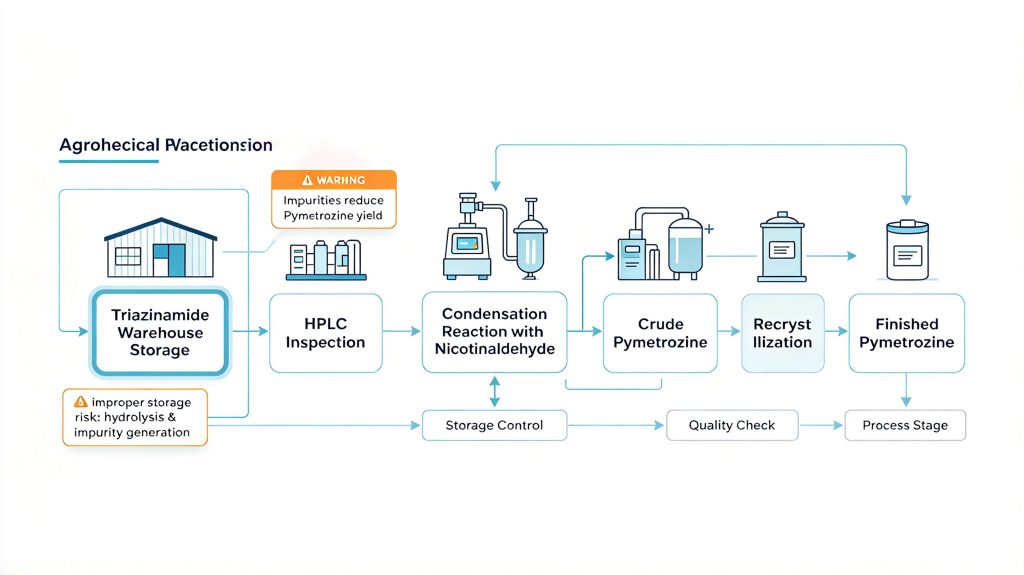
Triazinamide CAS 136738-23-3 Storage Risks & Impurity Effect on Pymetrozine Yield
Triazinamide (CAS No.: 136738-23-3) is the key intermediate for Pymetrozine synthesis. Improper storage of Triazinamide including high humidity, high temperature and light exposure causes hydrolysis, agglomeration and oxidation, generating aminotriazinone, acetate and triazine polymer impurities.
These impurities interfere with Pymetrozine condensation cyclization: they trigger competitive side reactions, inhibit reaction kinetics, cause co-crystallization loss during purification and mess up feeding stoichiometry. The final consequence is lower Pymetrozine yield, unstable batch quality and higher compliance risk for export.
Standard control: Keep Triazinamide sealed in cool dry storage. Test HPLC impurity profile before dosing to maintain stable Pymetrozine yield at 93–96%.
FAQ About Triazinamide, Storage Risks & Pymetrozine Production Yield
Q1: Why is Triazinamide (CAS 136738-23-3) such a vital intermediate for Pymetrozine?
A1: Triazinamide (CAS 136738-23-3) is the direct precursor in the mainstream condensation route of Pymetrozine. Its ring structure provides the core triazine skeleton of final Pymetrozine technical material. The quality and storage status of Triazinamide determine reaction selectivity, yield and final purity of Pymetrozine.
Q2: What is the biggest impurity formed when Triazinamide (CAS 136738-23-3) is stored in humid conditions?
A2: Moisture-induced hydrolysis mainly produces deacetylated aminotriazinone, accompanied by acetic acid and triazine oligomer impurities. These by-products are hard to remove and are the top cause of yield loss in subsequent Pymetrozine synthesis.
Q3: Can degraded Triazinamide still be used to produce Pymetrozine?
A3: It depends on the impurity level. Slightly degraded Triazinamide (CAS 136738-23-3) can be purified by recrystallization before feeding. If polymer impurities are too high, it should be discarded directly; otherwise, Pymetrozine yield will drop greatly and waste discharge will surge.
Q4: What is the recommended storage condition for Triazinamide for stable Pymetrozine production?
A4: Store Triazinamide (CAS 136738-23-3) in sealed drums, cool dry warehouse (temperature ≤25℃, relative humidity<60%), away from direct sunlight, acid, alkali and oxidizing agents. Avoid frequent opening of packaging during feeding.
Q5: What yield range of Pymetrozine can be achieved with qualified Triazinamide?
A5: When using high-purity Triazinamide (≥98.5% HPLC), the condensation step yield of Pymetrozine can steadily reach 93–96%. Poor-quality or improperly stored Triazinamide may cut yield by 5–12%.
Q6: Will impurities in Triazinamide affect Pymetrozine registration and export?
A6: Yes. Impurities carried into finished Pymetrozine may exceed regulatory impurity limits. It will fail agrochemical registration and international export inspection, even if the yield is acceptable.
References
[1] Ambeed. N-(6-Methyl-3-oxo-2,3-dihydro-1,2,4-triazin-4(5H)-yl)acetamide, CAS 136738-23-3, Material & Synthesis Data[EB/OL]. https://www.ambeed.com/products/136738-23-3.html [2] BenchChem. Triazinamide (CAS 136738-23-3), Pymetrozine Agrochemical Intermediate, Synthesis Specification[EB/OL]. https://www.benchchem.com/product/b189753[3] Syngenta. US5324842, Preparation of 1,2,4-triazin-3-one derivatives and Pymetrozine [P]. United States Patent, 1994. [4] AERU. Pymetrozine (CGA 215944) Agrochemical Synthesis Profile & Manufacturing Route Review[EB/OL]. https://aeru.herts.ac.uk/aeru/iupac/Reports/562.htm