Mercaptan sulphur scavenger:SOLASCAV 17 Product Introduction & Safety Instructions
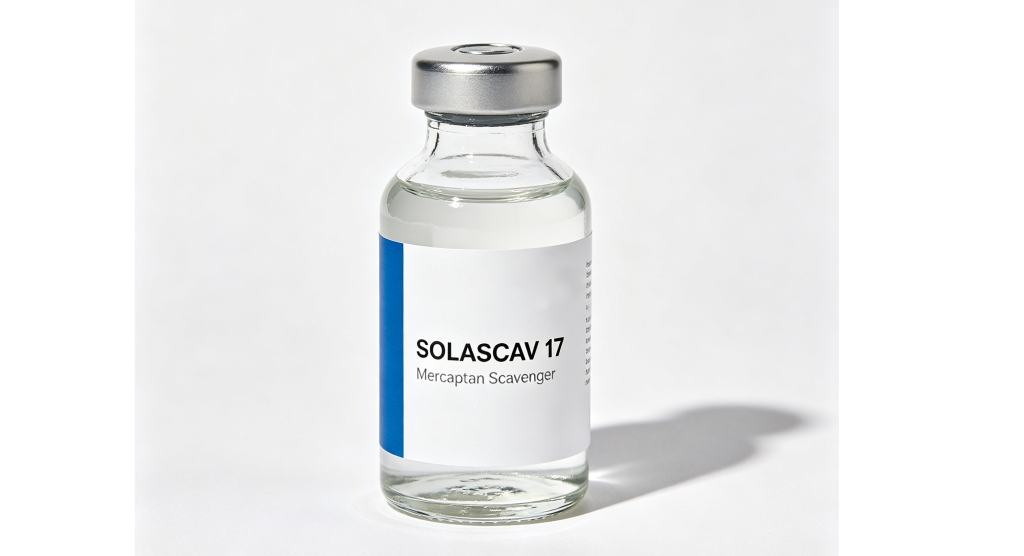
SOLASCAV 17
1. Basic Product Information
SOLASCAV 17 is a mercaptan sulphur scavenger. It is specially designed for mercaptan removal in cargoes to efficiently reduce mercaptan content and meet desulfurization requirements for oil products and related cargoes.
This product is supplied with a formal Certificate of Analysis (COA) and Safety Data Sheet (SDS), with complete testing and safety information suitable for shipping, storage and industrial field applications.
2. Physical and Chemical Properties (per COA & SDS)
- Appearance: Brown to brownish black, actual result: Brown liquid
- Density (20℃): 0.950–1.050 g/cm³, actual result: 0.998 g/cm³
- Flash Point (closed cup): >60℃, actual result: 73℃
- Pour Point: < -20℃, actual result: -29℃
- Stability: Stable under normal storage conditions
- Hazard Characteristics: Corrosive to metals, corrosive to skin, causes serious eye damage, acute and chronic hazards to aquatic environment
3. Product Performance and Advantages
SOLASCAV 17 shows significantly higher mercaptan removal efficiency than comparable products, with core advantages as follows:
- Highly Efficient Mercaptan RemovalOnly 10–15 ppm of SOLASCAV 17 is required to remove 1 ppm of mercaptan sulphur; other mercaptan scavengers normally require 20–30 ppm, meaning lower dosage and lower cost.
- Tested Removal PerformanceFor vessel samples with initial mercaptan level of 122 ppm, after adding 1000 ppm SOLASCAV 17:
- Mercaptan reduced to 27 ppm at 168 hours (7 days), average daily reduction 13.6 ppm
- Mercaptan removal rate reaches 91% at 96 hours
- Reaction continues over 10 days with further mercaptan reduction
- Effect of AgitationAgitation significantly accelerates mercaptan removal; SOLASCAV 17 still achieves high removal efficiency without agitation, with similar final performance.
4. Application Method and Operational Guidelines
- Trial DopeConduct laboratory dosage trials first to determine the appropriate dosage and verify compatibility with actual cargo.
- Dosing MethodMust be added at the top of the cargo because its density is higher than the cargo.
- Circulation and DispersionThe product has self-dispersing properties, but circulation is strongly recommended for full-scale tanks to ensure uniform dispersion and complete reaction.
- Reaction and SettlingThe additive reacts with mercaptans in the cargo to form oil-insoluble sulphide complexes, which settle at the bottom of the tank. The reaction and settling process takes several days for full-scale industrial tanks.
5. Safety Hazard Information (per SDS)
SOLASCAV 17 is a hazardous chemical with GHS classifications and hazards:
- Corrosive to metals (Category 1)
- Skin corrosion/irritation (Category 1)
- Serious eye damage/eye irritation (Category 1)
- Acute toxicity to aquatic life (Category 1)
- Chronic hazard to aquatic life (Category 3)
- Signal Word: Danger
Hazard Statements:
- H290: May be corrosive to metals
- H314: Causes severe skin burns and eye damage
- H318: Causes serious eye damage
- H400: Very toxic to aquatic life
- H412: Harmful to aquatic life with long lasting effects
6. Prevention and First Aid Measures
6.1 Prevention
- Keep only in original packaging
- Do not breathe dust, vapor or mist
- Wash hands thoroughly after handling; do not touch eyes
- Avoid release to the environment
- Wear protective gloves, protective clothing, eye/face protection
6.2 First Aid
- Skin Contact: Remove contaminated clothing immediately; rinse skin with plenty of water for several minutes. Launder contaminated clothing before reuse.
- Eye Contact: Rinse eyes immediately with plenty of water for at least 15 minutes. Remove contact lenses if present and easy to do; continue rinsing and seek medical help immediately.
- Inhalation: Move victim to fresh air; keep comfortable for breathing. Seek immediate medical attention if respiratory irritation, dizziness or nausea occurs.
- Ingestion: Rinse mouth. Do NOT induce vomiting. Do not give anything by mouth to an unconscious person. Seek immediate medical help.
7. Spill Handling, Firefighting, Storage and Disposal
7.1 Spill Handling
- Eliminate all ignition sources and isolate the spill area
- Use proper personal protective equipment before cleanup
- Absorb with inert materials (sand, diatomite, etc.)
- Prevent spillage from entering drains, waterways or sewers
- Dispose of contaminated absorbents in accordance with regulations
7.2 Firefighting
- Suitable Extinguishing Media: Water spray, foam, dry powder, carbon dioxide
- Wear self-contained breathing apparatus and full protective clothing in fire
- Incomplete combustion may produce CO₂, NOx, CO and other decomposition products
7.3 Storage
- Store in tightly closed, correctly labeled containers in cool and ventilated areas
- Keep away from heat, ignition sources and incompatible materials
- Use corrosion-resistant containers with resistant inner liners
- Store under lock and key
7.4 Waste Disposal
- Dispose of waste and contaminated absorbents in accordance with local/regional/national/international regulations
- Empty drums must be completely drained and handled by licensed contractors for recycling or disposal
8. Transportation Information
- UN Number: UN1824
- Proper Shipping Name: SODIUM HYDROXIDE SOLUTION
- Class: 8 (Corrosive Substances)
- Packing Group: II
- Applicable Codes: ADR, IMDG, IATA
9. Key Composition Information
- Proprietary component: 40–50 wt%
- Potassium carbonate: 5–15 wt%
- Sodium hydroxide: 2–7 wt%
- Primary Alcohol Ethoxylate: 1–4 wt%
- Unspecified ingredients contain no hazardous substances
10. Conclusion
SOLASCAV 17 is a high-efficiency, low-dosage, stable mercaptan sulphur scavenger suitable for mercaptan removal in shipping and industrial cargoes. Field tests confirm a 91% removal rate at 96 hours. As a Class 8 corrosive dangerous good, strict compliance with SDS requirements is mandatory throughout handling, storage and transportation to ensure personnel safety and environmental protection.
Q: What are the advantages of SOLASCAV 17 in mercaptan removal efficiency compared with similar products, and is agitation necessary under actual operating conditions?
A: The advantage is that the dosage is halved. Only 10–15 ppm of additive is needed to remove 1 ppm of mercaptan, while similar products require 20–30 ppm. Agitation is not mandatory but highly recommended, as it speeds up the reaction rate. Even without agitation, a high removal rate of 91% can still be achieved.
Q: Are the physical and chemical data in the COA and SDS consistent, and what is the significance of these data for on-site application?
A: The data are fully consistent, with a density of 0.998 g/cm³ and a flash point of 73℃. Its higher density than the cargo determines top feeding; the flash point above 60℃ reduces fire risk; the pour point of -29℃ ensures usability in low-temperature environments.
Q: What are the hazardous characteristics and transport classification of SOLASCAV 17, and what risks should be mainly prevented during on-site operation?
A: It is a Class 8 corrosive dangerous good with UN number 1824. Risks include metal corrosion, severe skin/eye burns, and extreme toxicity to aquatic organisms. Operations require chemical-resistant protection, closed ventilation, and strict prohibition against leakage into water.