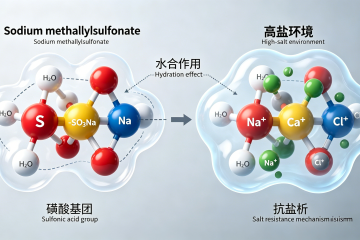
Why Sodium Methallyl Sulfonate Can Be Effectively Injected Without Plugging in the Middle and Late Stages of Low-Permeability Reservoirs

In the middle and late stages of low-permeability reservoirs, the pore structure is complex, with narrow throats and strong heterogeneity, making effective water injection and profile control extremely challenging. However, Sodium methallyl sulfonate (SMAS) can still be effectively injected without causing reservoir plugging, which is mainly attributed to its unique Read more
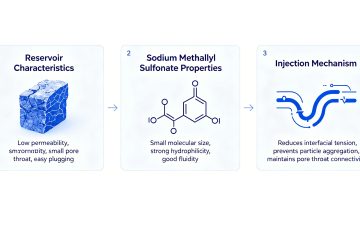
Why Sodium Methallyl Sulfonate Can Be Effectively Injected Without Plugging in the Middle and Late Stages of Low-Permeability Reservoirs

In the middle and late stages of low-permeability reservoirs, the pore structure is complex, with narrow throats and strong heterogeneity, making effective water injection and profile control extremely challenging. However, Sodium methallyl sulfonate (SMAS) can still be effectively injected without causing reservoir plugging, which is mainly attributed to its unique Read more
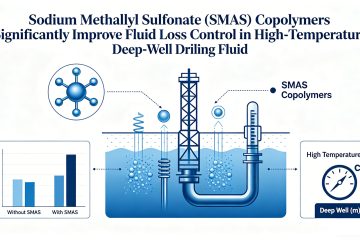
Sodium Methallyl Sulfonate (SMAS) Copolymers Significantly Improve Fluid Loss Control in High‑Temperature Deep‑Well Drilling Fluids

Why Sodium Methallyl Sulfonate (SMAS) Copolymers Significantly Improve Fluid Loss Control in High‑Temperature Deep‑Well Drilling Fluids

In deep‑well drilling fluids under high‑temperature conditions, sodium methallyl sulfonate (SMAS) copolymers significantly enhance fluid loss control primarily through an “adsorption‑hydration” synergistic film‑forming mechanism and the unique chemical stability of the sulfonate group (–SO₃⁻). Mechanism: Synergy between Adsorption and Hydration Stability under High‑Temperature Conditions High temperatures in deep wells severely challenge conventional polymers, Read more

Sodium Methallyl Sulfonate (SMAS / MAS)

Sodium Methallyl Sulfonate (SMAS / MAS / CAS No.: 1561-92-8)

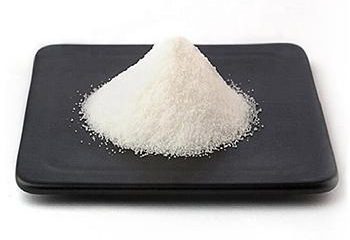
Sodium Methallyl Sulfonate (SMAS / MAS) CAS No.: 1561-92-8 Molecular Formula: C₄H₇NaO₃S Molecular Weight: 158.15 g/mol 1. Product Overview Sodium Methallyl Sulfonate (SMAS) is a high-purity, anionic monomer featuring a reactive allylic double bond and a strongly hydrophilic sulfonate group (-SO₃Na). It appears as a white crystalline powder/flake, highly soluble in water, Read more

Are there any new developments in the field of industrial VOCs catalysts?

Industrial VOCs catalysts have seen major breakthroughs in low-noble/non-noble performance, anti-poisoning, manufacturing, and multi-pollutant integration since 2025–2026. Below are the key new developments: 1. Single-Atom & Dual-Metal Catalysts (Cost & Activity Breakthrough) 2. Non‑Noble Metal Oxides (Cost‑Effective Alternatives) 3. Advanced Manufacturing & Structured Catalysts 4. Anti‑Poisoning & Multi‑Pollutant Control 5. AI & Read more

Industrial VOCs Catalysts: An Overview of Types, Performance and Applications

A systematic, in-depth overview of Industrial VOCs Catalysts (Volatile Organic Compounds Catalysts for industrial emission control), covering their working principles, main types, key performance metrics, typical applications, deactivation & mitigation, and recent technical trends. 1. Core Principle & Process Industrial VOCs catalytic oxidation relies on catalysts to lower the activation energy for Read more

Industrial VOCs Catalyst: Advanced Solutions for Volatile Organic Compound Emission Control

Introduction Volatile Organic Compounds (VOCs) are organic chemicals that easily vaporize at room temperature and are widely present in industrial production processes. Common VOCs include benzene, toluene, formaldehyde, and various solvents emitted from chemical manufacturing, coating operations, printing industries, and petrochemical facilities. These compounds not only contribute to environmental problems Read more

Industrial VOCs Catalyst: Advanced Solutions for Volatile Organic Compound Emission Control

Introduction Volatile Organic Compounds (VOCs) are organic chemicals that easily vaporize at room temperature and are widely present in industrial production processes. Common VOCs include benzene, toluene, formaldehyde, and various solvents emitted from chemical manufacturing, coating operations, printing industries, and petrochemical facilities. These compounds can contribute to environmental concerns such Read more

Detailed Specifications of ChevYoung VOCs Catalysts

1. Universal High-Efficiency Catalyst 2. Short-Chain Alkane Catalyst 3. Long-Chain Alkane Catalyst 4. Partial Oxidation Tail Gas Catalyst 5. Sulfur Poisoning Resistant Catalyst 6. Chlorine Poisoning Resistant Catalyst 7. Nitrogen-Containing VOCs Specific Catalyst 8. Carbon Monoxide Catalyst 9. Ammonia Oxidation Catalyst Catalyst Specifications and Materials Core Product Advantages

About ChevYoung Chemical

Since its establishment in February 2002, Chevyoung Chemical has been deeply engaged in the fine chemical industry. Endowed with professional R&D capabilities, standardized production systems, and prudent development strategies, the company has gradually developed into a fine chemical manufacturer with core competitiveness in the industry. Headquartered in Weifang, Shandong Province, Read more