Why Sodium Methallyl Sulfonate Can Be Effectively Injected Without Plugging in the Middle and Late Stages of Low-Permeability Reservoirs
In the middle and late stages of low-permeability reservoirs, the pore structure is complex, with narrow throats and strong heterogeneity, making effective water injection and profile control extremely challenging. However, Sodium methallyl sulfonate (SMAS) can still be effectively injected without causing reservoir plugging, which is mainly attributed to its unique physical and chemical properties and its synergistic effect with reservoir conditions.
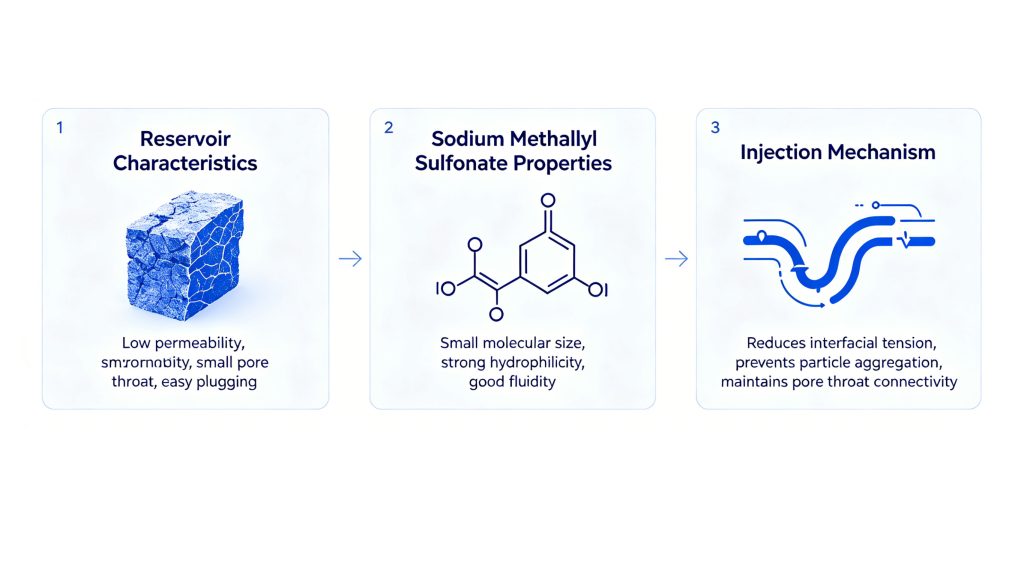
Firstly, Sodium methallyl sulfonate has excellent water solubility; it can be quickly dissolved in injected water to form a uniform and stable aqueous solution, even under the high-salinity and high-temperature conditions of low-permeability reservoirs in the middle and late stages. Its solubility avoids the formation of insoluble precipitates that would block the reservoir’s narrow throats. Unlike some polymers prone to aggregation and precipitation, the molecular structure of Sodium methallyl sulfonate contains a highly hydrophilic sulfonic acid group, which enhances its dispersion stability in water and prevents molecular agglomeration.
Secondly, Sodium methallyl sulfonate has a moderate molecular weight and a linear molecular structure, which endow it with good fluidity and injectability. In low-permeability reservoirs, throat diameters are usually small (often less than 100 md), and substances with excessively high molecular weight or irregular structures are easily retained in the throats, leading to plugging. However, the molecular weight of Sodium methallyl sulfonate is controlled within a reasonable range, and its linear structure allows it to pass smoothly through narrow throats under normal injection pressure without being trapped. Meanwhile, its moderate viscosity will not significantly increase injection pressure or cause pore blockage due to excessive thickness.
Thirdly, Sodium methallyl sulfonate has good compatibility with reservoir rocks and fluids. In the middle and late stages of low-permeability reservoirs, formation water often has high salinity and mineralization, and reservoir rocks are prone to clay swelling and particle migration, which can easily cause plugging. Sodium methallyl sulfonate can weakly adsorb on the surface of reservoir rocks; this not only inhibits clay swelling and particle migration but also does not form a dense adsorption layer that would block pores. Its sulfonic acid group can also reduce the interfacial tension between oil and water, improve reservoir wettability, and further facilitate its smooth injection without causing additional plugging.
In addition, when Sodium methallyl sulfonate is used for profile control and flooding, it can form a weak gel with appropriate crosslinking agents under reservoir conditions. This weak gel has good deformability and can be injected into the deep reservoir along with injected water. It will not prematurely form a rigid gel to block the near-wellbore area but will gradually exert a profile control effect in the deep reservoir, forcing injected water to divert to low-permeability oil-bearing zones, thereby achieving effective profile control and flooding without causing reservoir plugging.