Detailed Reaction Mechanisms of Mercaptan Scavengers
1. General Reaction Principle
Mercaptan scavengers work by chemically reacting with mercaptan groups (R–SH)
to transform odorous, corrosive, reactive mercaptans into stable, odorless, non‑corrosive products.
The core target is the thiol group (–SH).
Main reaction pathways:
- Nucleophilic addition / condensation
- Oxidation to disulfides
- Nucleophilic substitution
2. Reaction Mechanism of Triazine-Based Scavengers
Triazines are the most widely used water‑soluble mercaptan scavengers,
typically based on hexahydro‑1,3,5‑tris(hydroxyethyl)triazine (HET Triazine).
Reaction Steps:
- Under weakly alkaline conditions, triazine ring opens gradually.
- Mercaptan (RSH) acts as a nucleophile and attacks the electrophilic carbon on the triazine ring.
- One, two, or three R–S– groups can substitute onto the triazine structure.
- Stable water‑soluble adducts form with no odor and low corrosion.
Simplified overall reaction:
Triazine+3 RSH→Triazine–(SR)3+3 H2O
Characteristics:
- Fast reaction rate
- High mercaptan‑removal efficiency
- Alkaline nature
- May form precipitates at high dosage or low pH
3. Reaction Mechanism of Aldehyde-Based Scavengers
Typical agents: glyoxal, formaldehyde derivatives, modified aldehydes.
Reaction Steps:
- Aldehyde group (–CHO) undergoes nucleophilic addition with RSH.
- Forms a hemithioacetal intermediate.
- Further condensation yields stable thioacetal or polymeric thioether structures.
Overall reaction:
R–CHO+2 R’SH→R–CH(SR’)2+H2O
Characteristics:
- Mild, low amine odor
- Less fouling than triazines
- Good compatibility in oil‑water systems
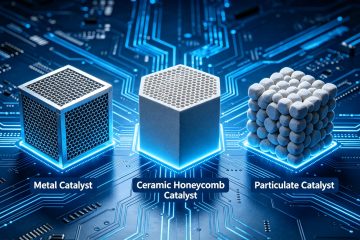
4. Reaction Mechanism of Metal‑Catalyzed / Oxidative Scavengers
Common active components: Cu, Zn, Fe salts or oxides.
Reaction Steps:
- Metal ions act as oxidation catalysts.
- Mercaptans are oxidized by oxygen or oxidizing components present in the fluid.
- Two mercaptan molecules couple to form disulfide (R–S–S–R).
Overall reaction:
2 RSH+21O2Metal catalystR–S–S–R+H2O
Characteristics:
- Forms oil‑soluble disulfides
- No strong alkaline effect
- Suitable for both gas and liquid phases
- Disulfides are odorless and much less corrosive
5. Reaction Mechanism of Non‑Amine, Non‑Triazine Scavengers
Modern high‑performance scavengers use reactive nucleophilic molecules such as:
- activated olefins
- polyfunctional esters
- cyclic ethers
Mechanism:
- Direct Michael addition or nucleophilic substitution with RSH
- Forms stable covalent C–S bonds
- No formaldehyde, no triazine, no amine release
- Very low fouling and good compatibility
6. Comparison of Three Main Mechanisms
表格
| Type | Reaction Pathway | Main Product | Features |
|---|---|---|---|
| Triazine | Nucleophilic substitution | Water‑soluble adducts | Fast, high efficiency, alkaline |
| Aldehyde | Addition‑condensation | Thioacetals | Mild, low fouling |
| Oxidative | Catalytic oxidation | Disulfides (RSSR) | Oil‑soluble, no alkalinity |
7. Key Factors Affecting Reaction Rate
- pH value: triazines favor alkaline; aldehydes work over wider pH
- Temperature: higher temperature generally accelerates reaction
- Mixing intensity: improves contact between scavenger and mercaptans
- Water / oil ratio: determines which type of scavenger is preferred
- Impurities: H₂S, CO₂, salts may interfere