Full Chemical Introduction to Triazinamide (CAS 136738-23-3)
1. Basic Identification & Nomenclature
Core Registry Data
- CAS Number: 136738-23-3
- Common Name: Triazinamide / Pymetrozine Intermediate (P4)
- IUPAC Full Name: 4-Acetylamino-6-methyl-3-oxo-2,3,4,5-tetrahydro-1,2,4-triazine
- Systematic Aliases:N-(6-methyl-3-oxo-2,5-dihydro-1,2,4-triazin-4 (3H)-yl) acetamide
Chinese Name: 4 – 乙酰氨基 – 6 – 甲基 – 3 – 氧代 – 2,3,4,5 – 四氢 – 1,2,4 – 三嗪 - HS Code: 2933699099 (Heterocyclic compounds with triazine ring)
- EINECS: Not officially assigned
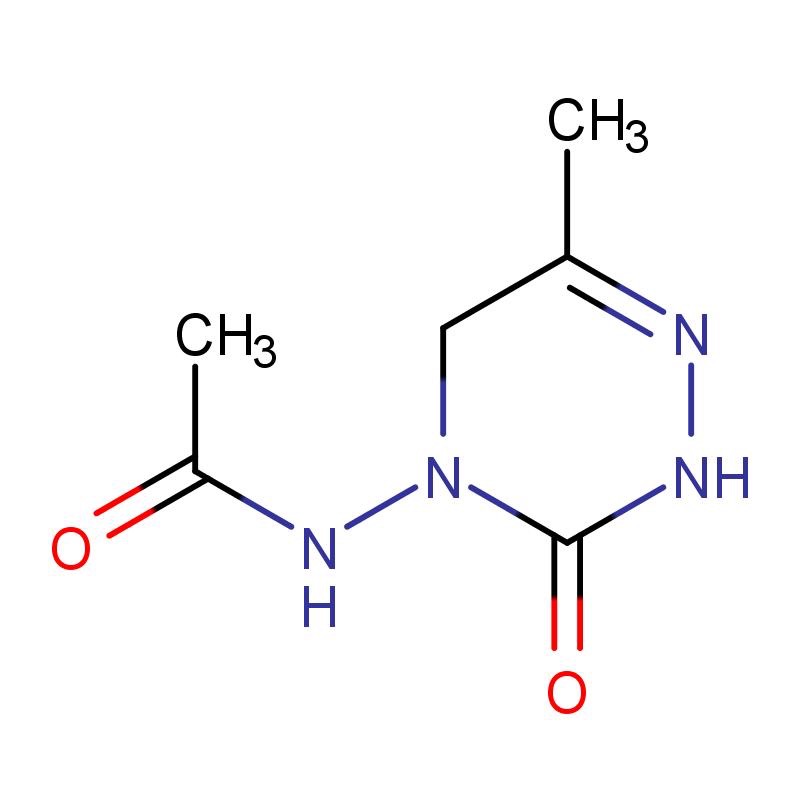
Molecular Coding
- Molecular Formula: C6H10N4O2
- Exact Molecular Weight: 170.169 g/mol
- SMILES: CC(=O)NN1CC(C)=NNC1=O
- InChI: 1S/C6H10N4O2/c1-4-3-10(9-5(2)11)6(12)8-7-4/h3H2,1-2H3,(H,8,12)(H,9,11)
- InChIKey: NCSCAWXVGUIUEY-UHFFFAOYSA-N
2. Molecular Structure & Skeleton Features
- Parent Heterocycle: Saturated 1,2,4-tetrahydrotriazine six-membered nitrogen heterocycle containing three nitrogen atoms inside the ring. It is a fully saturated aliphatic triazine framework, which is completely different from aromatic 1,3,5-triazine herbicides.
- Ring Substituents:
- C6 position: Methyl group (-CH3)
- C3 position: Lactam carbonyl (C=O) forming cyclic amide structure
- N4 ring nitrogen: Acetylamino side chain (-NH-COCH3), which serves as the core reactive functional group for subsequent coupling reactions
- Key structural traits:
- Multiple hydrogen bond donors and acceptors, including 2 amide NH groups, 2 carbonyl oxygen atoms and 4 ring nitrogen atoms
- Moderately electron-deficient heterocyclic ring, susceptible to nucleophilic substitution at N4 site
- Free of aromatic conjugation; the saturated ring has flexible conformation and low steric hindrance, facilitating condensation reactions
3. Physical-Chemical Properties
| Property | Parameter | Note |
|---|---|---|
| Appearance | White / off-white crystalline powder | Industrial grade solid |
| Predicted Density | 1.43 ± 0.1 g/cm³ | Computational calculation value |
| Partition Coefficient (LogP) | -0.708 | Strong hydrophilicity, soluble in water |
| Predicted pKa | 11.22 ± 0.40 | Weakly acidic lactam N-H bond |
| Solubility | Soluble in hot water and polar aprotic solvents (DMF, DMSO); slightly soluble in methanol; insoluble in ether and alkane solvents | |
| Thermal Stability | Stable under conventional storage conditions; decomposes above 220 °C | Toxic substances including NH3, N2 and small-molecule nitrogen-containing volatile organics will be released during thermal degradation |
| Hygroscopy | Low hygroscopicity; stable under ambient humidity | No deliquescence in dry air environment |
| Melting Point | 218–224 °C (purified industrial grade) | Decomposition occurs near the melting point |
4. Chemical Reactivity
4.1 Hydrolysis Reactions
- Acid-catalyzed hydrolysis: The terminal acetyl group is cleaved to produce 4-amino-6-methyl-3-oxo-tetrahydrotriazine, the direct precursor for pymetrozine condensation synthesis
- Alkaline hydrolysis can accelerate the cleavage of ring lactam under strong alkaline conditions with heating
4.2 Condensation & Coupling (Core Industrial Reaction)
The N-H bond on acetylamino group is the primary reactive site:
- It can undergo condensation reaction with pyridine-3-carboxaldehyde under mild acid catalysis to generate Schiff base, which is then reduced to synthesize Pymetrozine, a mainstream insecticide targeting piercing-sucking pests
- It participates in nucleophilic addition, reductive amination, carbonyl cross-coupling and other reactions to derive various agrochemical intermediates
4.3 Oxidation & Reduction
- Mild oxidants (hydrogen peroxide, high-temperature air) can oxidize saturated triazine ring to generate unsaturated triazinone by-products
- Catalytic hydrogenation has no destructive effect on stable lactam and acetylamino functional groups
4.4 Salt Formation
It can form weak inorganic salts with strong mineral acids (hydrochloric acid, sulfuric acid) via protonation on ring nitrogen atoms; such salts possess higher water solubility and are suitable for liquid-phase synthesis processes
5. Industrial Synthetic Routes
Main Mass Production Route
- Raw materials: Methylthiosemicarbazide and ethyl pyruvate undergo cyclization to obtain 6-methyl-3-oxo-tetrahydro-1,2,4-triazin-4-amine (triazinamine intermediate)
- Acetylation stage: React with acetic anhydride or acetyl chloride under weak base (triethylamine) at 40–60 °C
- Purification by recrystallization: Recrystallized with hot water to reach industrial standard with purity ≥99.0%
- Filtration and low-temperature drying to obtain white crystalline triazinamide solid
Minor Laboratory Synthetic Route
Thermal cyclization of cyanamide and urea followed by acetylation post-treatment; this process features low yield and is only applied to small-batch laboratory preparation, lacking economic value for large-scale production
6. Primary Application: Core Intermediate for Agrochemicals
6.1 Exclusive Main Application: Synthetic Precursor of Pymetrozine
Triazinamide is an essential penultimate intermediate for manufacturing Pymetrozine, a selective systemic insecticide developed by Syngenta.
- Synthetic process: Triazinamide reacts with 3-pyridinecarboxaldehyde to form Schiff base, followed by reduction to obtain technical pymetrozine
- Target pests of pymetrozine: Aphids, whiteflies, planthoppers, leafhoppers and other piercing-sucking pests
- Insecticidal mechanism of finished product: Block serotonin signal transmission in insect stylets, leading to irreversible feeding cessation (stylet blocking effect)
6.2 Secondary Research-Oriented Applications
- Nitrogen heterocyclic building block for medicinal chemistry candidate compounds
- Precursor of ligands for metal coordination complexes in catalyst research
- Nitrogen-rich monomer for laboratory synthesis of polyamides and COFs (covalent organic frameworks)
7. Industrial Quality Control Specifications
- HPLC Purity: ≥99.0% (technical grade); ≥99.5% (high-purity fine intermediate grade for pharmaceutical use)
- Moisture Content: ≤0.3%
- Hot Water Insoluble Substances: ≤0.1%
- Heavy Metal Impurities (Pb, As, Cd): <10 ppm
- Residual Acetic Acid: ≤0.2%
8. Safety, Toxicology & Operation Guidelines
8.1 Hazard Characteristics
- Irritates skin, eyes and respiratory mucous membranes; direct contact and dust inhalation should be avoided
- Toxic nitrogen oxide and ammonia fumes are generated during thermal decomposition
- Non-flammable solid, but will accelerate combustion when mixed with strong oxidants
8.2 Personal Protective Equipment
Dust respirators, chemical-resistant gloves and safety goggles shall be worn during weighing and synthetic operation procedures
8.3 Storage & Transportation Requirements
- Storage: Sealed 25kg woven bags lined with PE inner film; store in cool, dry and ventilated warehouses, separated from oxidants, strong acids and food-related chemicals
- Transportation: Classified as general industrial chemicals without dangerous goods labels; prevent rain soaking and high temperature exposure during transit
8.4 Waste Disposal Regulations
Solid waste shall be incinerated in special chemical incinerators equipped with tail gas absorption devices; wastewater shall be neutralized before discharge in compliance with local environmental protection standards
9. Market & Production Overview
- Global monthly industrial production capacity: Approximately 100 metric tons
- Bulk price: FOB USD 4–6/kg for orders above 1000kg; USD 35–40/kg for small batches of 1–200kg
- Major manufacturers: Fine chemical enterprises distributed in Jiangsu, Zhejiang and Shandong Provinces of China, supplying raw materials to global pymetrozine technical manufacturers