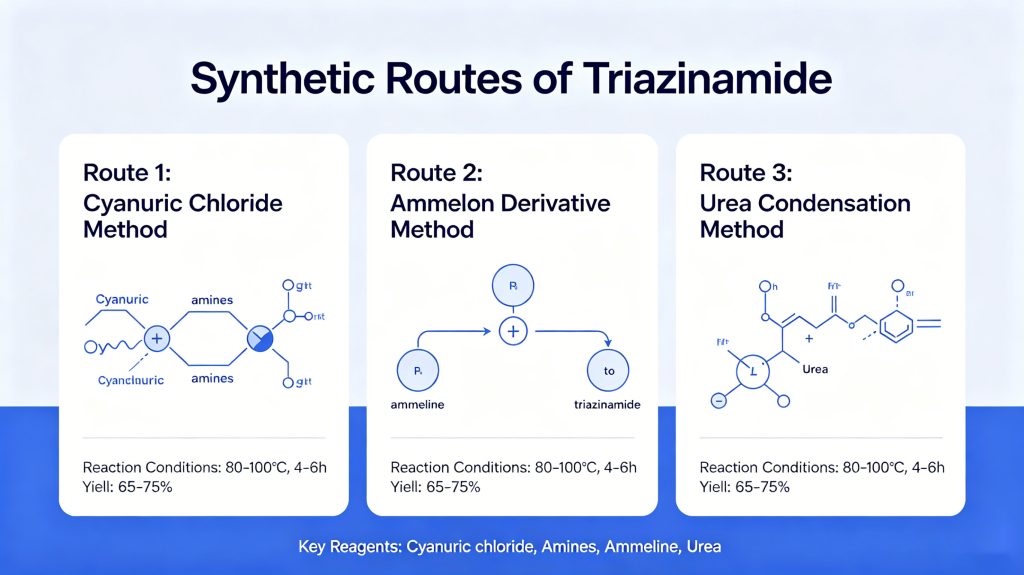
Synthetic Routes of Triazinamide
1. Dominant Industrial Route (Hydrazinolysis of Acetonyloxadiazolone)
This is the only mass-production process adopted worldwide.
- Methyloxadiazolone undergoes alkylation with chloroacetone in toluene solvent to produce acetonyloxadiazolone.
- After solvent removal, ethanol and hydrazine hydrate are added; hydrazinolysis ring expansion proceeds at 75–85°C.
- Cool down for crystallization, centrifugal washing and drying to obtain finished triazinamide.
- Merits: Low-cost raw materials, stable operation, HPLC purity ≥98%, single-step yield over 95%.
- Molar ratio: Methyloxadiazolone : Chloroacetone : Hydrazine hydrate ≈ 1 : 1.5 : 1.8.
2. Improved High-Purity Pentanol Solvent Process (Fine Purification Grade)
High-temperature reaction in pentanol at 100°C with dropwise addition of hydrazine hydrate. Cyclohexanone aids water separation and impurity removal, then low-temperature precipitation and filtration.
- Advantage: Ultra-high purity up to 99% for pharmaceutical-grade use.
- Disadvantage: Higher solvent cost, smaller production scale.
3. Obsolete Trifluoroethyl Acetate Precursor Route (Historical Lab Process)
Trifluoro-substituted oxadiazolone is synthesized first, then cyclized via hydrazinolysis, followed by defluorination hydrolysis to yield triazinamide.
- Critical drawbacks: Expensive fluorinated feedstock, massive waste discharge, severe equipment corrosion; fully phased out commercially.
4. One-Pot Multi-Component Trial Route (Lab Only, No Scale-Up)
One-pot cyclization of acetohydrazide, acetone derivatives and hydrazine hydrate to skip acetonyloxadiazolone intermediate.
- Drawbacks: Poor reaction selectivity, abundant by-products, total yield below 60%; unfit for industrial manufacturing.