VOCs Catalysts – Catalytic Oxidation Catalysts for Volatile Organic Compounds
Full name: Volatile Organic Compounds Oxidation Catalysts.
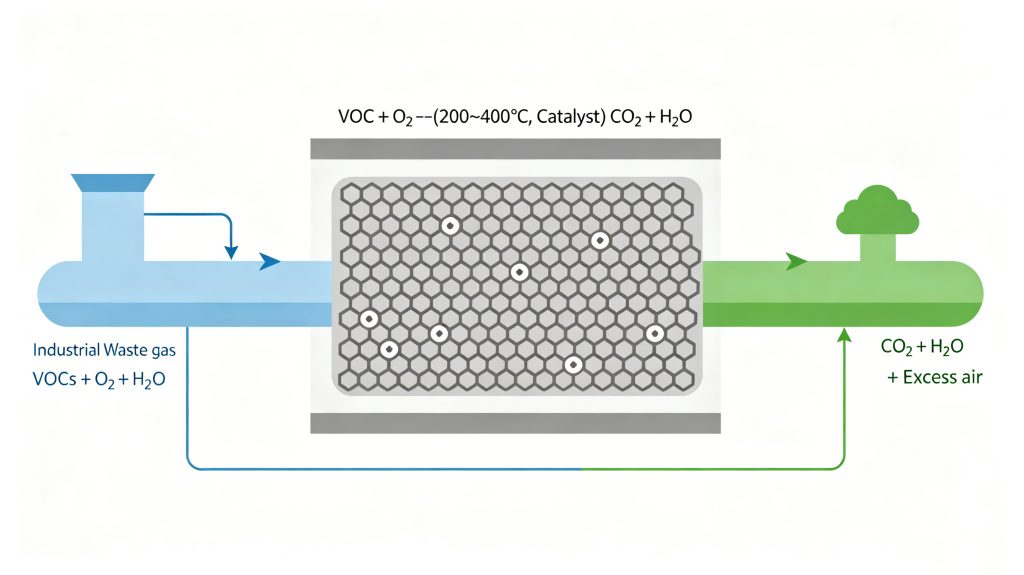
Core principle: At moderate temperature of 200–400 ℃, catalysts activate oxygen to completely oxidize benzene, esters, ketones, alcohols and other VOCs in waste gas into carbon dioxide and water without secondary solid waste. They are core consumables for RCO & RTO regenerative catalytic incineration systems.
1 Three Main Industrial Catalyst Types
1.1 Precious Metal Catalysts (Pt/Pd-based, premium industrial grade)
Active components: Platinum (Pt), Palladium (Pd) and trace Rhodium (Rh), supported on γ-Al₂O₃ coated honeycomb ceramic carriers.
Operating parameters: Light-off temperature: 180–260 ℃, VOC removal efficiency ≥99%, tolerable to low-concentration water vapor.
Advantages: Outstanding low-temperature activity; applicable to refractory VOCs such as benzene series and halogenated organics.
Disadvantages: High raw material cost of noble metals; vulnerable to poisoning by phosphorus, silicon and heavy metals.
Application: Automobile coating, pharmaceutical manufacturing, printing, electronic photolithography waste gas & fine chemical tail gas with low pollutant concentration.
1.2 Non-precious Metal Oxide Catalysts (Mn/Cu/Co-based, cost-effective grade)
(1) Mn-Cu composite spinel oxide (CuMn₂O₄, mass-produced mainstream)
Light-off temperature for toluene: approx. 260 ℃; excellent catalytic performance for oxygen-containing VOCs (alcohols, esters, ketones); raw material cost is only 1/5 of noble metal catalysts.
Defect: Max heat resistance ≤450 ℃, prone to high-temperature sintering, poor chlorine poisoning resistance.
(2) Perovskite ABO₃ (La-Co, La-Mn system)
Abundant lattice defects with strong deep oxidation capacity; mainly applied for CVOCs (chlorinated VOCs) treatment and high-temperature chemical tail gas.
Application: Furniture spraying, coating industry, plastic processing & small-to-medium coating factories with cost-control requirements.
1.3 Zeolite-supported Catalysts (ZSM-5/Y zeolite substrate)
Pd/Mn doped ZSM-5 zeolite. Zeolite pores enrich VOCs via selective adsorption, suitable for multi-component mixed waste gas with low concentration; preferred for isopropanol & ethyl acetate exhaust from electronics industry with dual adsorption & catalytic functions.
2 Common Carrier Shapes for Industrial Molding
- Honeycomb monolithic catalyst (dominant): Cordierite honeycomb substrate (100/200/300 cpsi), coated with alumina washcoat + active components; low bed resistance & good heat exchange, standard filler of RCO equipment.
- Metal honeycomb carrier: Fe-Cr-Al alloy substrate with fast thermal conductivity for instant high-temperature working conditions.
- Pellet/extruded catalyst: Used in fixed-bed small waste gas treatment units.
3 Typical Application Industries
Coating & spraying, printing ink, pharmaceutical, petrochemical, rubber vulcanization, PTA production, wood-based panel, food fermentation & plastic molding waste gas abatement.
4 Quick Selection Guide
- Low temperature + high benzene pollutants + strict emission standard → Pt-Pd noble metal catalyst
- Oxygen-containing solvent waste gas + cost budget control → Mn-Cu non-noble metal oxide catalyst
- Low-concentration mixed organic waste gas → Zeolite-supported catalyst