Why Sodium Methallyl Sulfonate (SMAS) Copolymers Significantly Improve Fluid Loss Control in High‑Temperature Deep‑Well Drilling Fluids
In deep‑well drilling fluids under high‑temperature conditions, sodium methallyl sulfonate (SMAS) copolymers significantly enhance fluid loss control primarily through an “adsorption‑hydration” synergistic film‑forming mechanism and the unique chemical stability of the sulfonate group (–SO₃⁻).
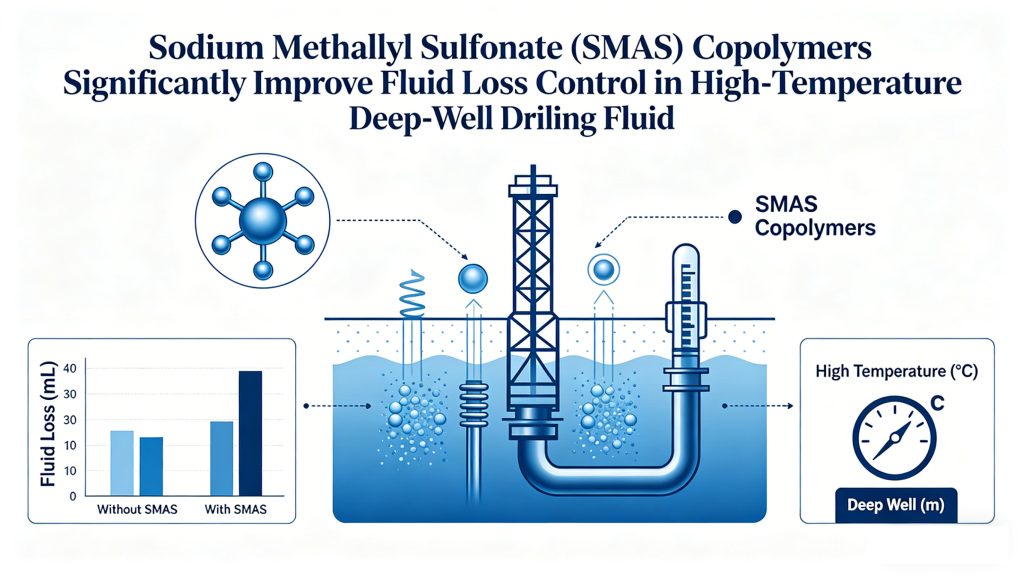
Mechanism: Synergy between Adsorption and Hydration
- Step 1: Strong Adsorption
The strongly anionic sulfonate groups (–SO₃⁻) of the SMAS copolymer adsorb firmly onto the positively charged edges of solid particles in the drilling fluid, such as clay and barite. This provides a stable “anchor” for subsequent interactions. - Step 2: Efficient Hydration
After adsorption, the highly hydrophilic groups on the polymer chain attract a large number of water molecules, forming a substantial hydration layer around themselves and the adsorbed particles. This hydration layer expands the polymer volume, increases fluid viscosity, and – more importantly – effectively seals the micropores within the filter cake, creating a dense, smooth, and low‑permeability physical barrier. - Step 3: Dynamic Sealing
The SMAS copolymer can combine with nano‑sized clay particles via hydrogen bonding to form a dense network structure. Experimental data show that this reduces the average pore diameter of the filter cake from 5 μm to as low as 0.1–0.5 μm, greatly hindering filtrate invasion. Moreover, the sulfonate groups enable a self‑healing effect: any micro‑defects in the filter cake caused by downhole erosion are promptly repaired, maintaining continuous and stable fluid loss control.
Stability under High‑Temperature Conditions
High temperatures in deep wells severely challenge conventional polymers, but SMAS copolymers offer unique advantages:
- Excellent Thermal Stability
The carbon‑sulfur (C–S) bonds in SMAS are highly stable. SMAS‑containing copolymers retain their hydration ability at temperatures up to 150 °C, which is about 40 °C higher than conventional HPAM‑based polymers. Some studies report that through nanocomposite modification, the temperature resistance can be further increased to 180 °C or above. - Validated High‑Temperature Performance
Laboratory evaluations confirm this stability. For example, a quaternary copolymer fluid loss reducer containing SMAS, after hot rolling at 150 °C for 16 hours, still maintained a filtrate volume of only 12.6 mL/30 min. Under ultra‑high temperature (210 °C), certain SMAS‑based polymers have been shown to keep the filtrate volume of fresh water‑based mud around 13.5 mL.
Adaptability to High‑Salinity and High‑Hardness Environments
Deep‑well drilling fluids often encounter high salinity and high hardness. SMAS copolymers are particularly well‑suited to these challenges:
- Salt Resistance Mechanism
Unlike the carboxylate group (–COO⁻) in conventional polymers, which forms insoluble precipitates with divalent cations such as Ca²⁺ and Mg²⁺, the sulfonate group in SMAS forms highly soluble salts with these ions. Consequently, SMAS copolymers maintain their water solubility and extended chain conformation even in environments rich in Ca²⁺ and Mg²⁺ (e.g., Ca²⁺ > 5000 mg/L). Their salt resistance is 3 to 5 times higher than that of carboxylate‑containing polymers. - Validation in Seawater‑Based Drilling Fluids
This excellent salt tolerance has been verified in extreme environments. For instance, in seawater‑based drilling fluids with a chloride concentration as high as 180,000 ppm, systems containing SMAS still exhibit low filtrate volumes (< 15 mL/30 min).
Summary
Sodium methallyl sulfonate (SMAS) copolymers significantly improve fluid loss control in high‑temperature deep‑well drilling fluids through a strong adsorption‑hydration synergy that forms a dense filter cake, combined with the exceptional thermal and salt resistance conferred by the sulfonate group. These properties make SMAS copolymers far superior to conventional additives, ensuring drilling safety and efficiency under challenging downhole conditions.